
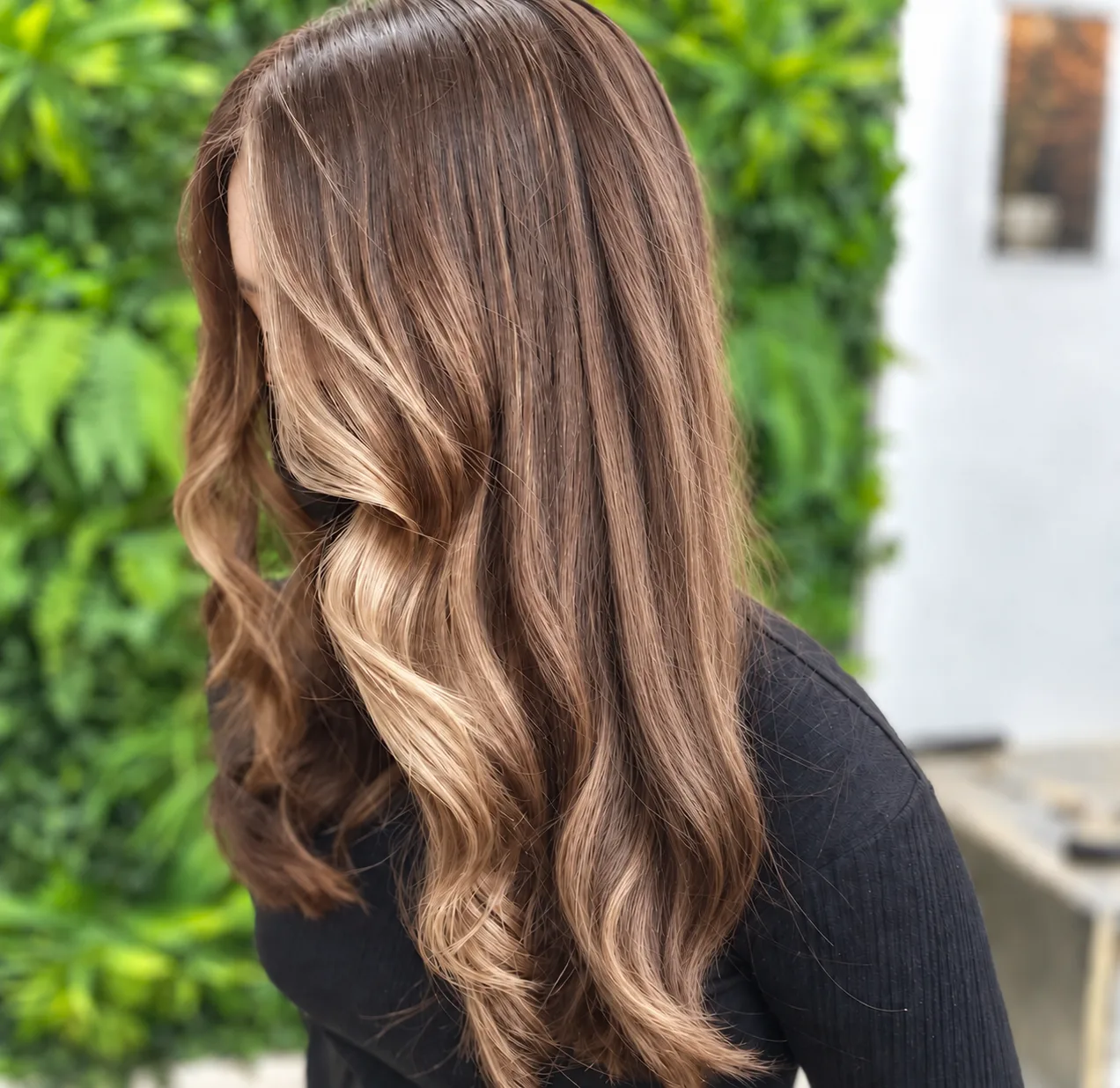
Bronde Hair: What?
By Johnny Ciccone · Headbetter, Encino
How To Talk To Your Hairstylist About Bronde Haircolor.
You can like the blonde in a photograph and still have no desire to be the blonde in the photograph. Maybe it’s that little bit around her face, or the way the lighter pieces disappear into the brown and turn up again farther down. You save the picture. Then you find another one, a little darker, and now you like that one too.
This is a perfectly reasonable way to arrive to a hair appointment.
Somewhere in that collection of pictures is what we’ve started calling bronde. Brown and blonde, smushed together into a word that sounds slightly unfinished. The color itself can be beautiful. Whether it’s the right color for you takes a little more conversation.
What Is Bronde Hair?
Bronde sits between brunette and blonde, with room to lean in either direction. It can be warm, neutral, or cool. So when you say “bronde,” I still want to know what you’re imagining.
Is it brown hair with light moving through it? Is it blonde hair with some of its depth put back? How much darkness do you like near your face? And when you look at the picture, are you looking at the color, or have you fallen for the haircut and the woman’s cheekbones? That happens. We should probably catch it before we start mixing.
The name gives us somewhere to begin. The pictures help us get specific.
The Brown Deserves Some Attention
It’s easy to become occupied with the lighter pieces. They’re the ones catching your eye, and once you start imagining them, you can keep adding a little more. More around the face. More through the ends. Then a little more between those pieces. At some point, the brown you liked in the original picture has become a very small participant.
For a dimensional bronde, I want to look at what stays dark as carefully as what goes light. Follow one lighter strand through a photograph. Where does it begin? What surrounds it? Does it remain visible all the way down, or slip behind something deeper? Those small relationships are worth noticing.
That’s also why I want to see the whole picture. A close-up of a few lovely highlights can tell us something about tone, but it doesn’t show us how much brown is left.
Bronde and Balayage Are NOT the Same Thing
Bronde describes the color. Balayage is a hand-painted highlighting technique. A bronde result might involve balayage, foils, lowlights, a gloss, or a combination.
You don’t need to figure out the application before you come in. That’s my job. I got you.
Tell me what you like about the result. If it’s the softness near the root, point to that. If it’s the brighter ends, say so. There’s much more useful information in “I like how this stays brown underneath” than in ordering a technique you’ve heard produces natural-looking hair.
Lets Talk about how you actually wear it. If your hair spends most of its life straight, I want us looking at straight hair too. Those big, loose salon waves are lovely, but they can keep us very busy admiring the styling.
Warm Bronde, Cool Bronde, and All These Food Names
Honey. Caramel. Toffee. Mushroom. Hair color has developed quite a menu.
The names can help, provided we’re picturing roughly the same thing. Warm bronde usually suggests golden or caramel tones; cooler versions move toward muted beige or ash. Neutral sits somewhere between.
But my idea of caramel may be darker than yours. Your “ash” might be a soft beige, while someone else is imagining something nearly gray. I’d rather have a photograph between us than discover our disagreement after the appointment.
Look at several pictures together. You may find that you consistently like a little warmth, even though you’ve been asking for cool hair. Or that every picture you save has a deeper root, although you thought you wanted to be lighter everywhere.
That’s useful. We can work with what you keep choosing.
Can Brunettes Go Bronde?
Yes. The starting point matters, particularly whether the hair is natural or has been colored before. Color history, condition, and the desired result all belong in the consultation before choosing a lightening plan.
Bring the history along with the pictures. If there’s old dark color in the lengths, tell me. If you’ve been doing something at home, tell me that too. I need to know what’s on the hair.
Then we can talk about how far you actually want to travel from brunette. You may want brightness around your face and very little change underneath. You may want something more noticeable through the lengths. Both conversations can begin with “bronde” and end in quite different places.
A picture that’s too blonde is useful here. It gives us a boundary. Show me where you start thinking, That’s pretty, but I wouldn’t feel like myself.
Can Blondes Go Bronde?
Yes. Adding depth through lowlights or a deeper root can move blonde hair toward bronde. The part I’d want to settle first is where you still want to feel blonde.
You might be ready for darker hair through the back but attached to the brightness around your face. You might like your light ends and want more depth above them. “I want to go darker” leaves all of that open. So let’s look at the blonde you want to keep. We can be quite deliberate about that. You don’t have to surrender every light piece because you’re tired of the overall color.
Is Bronde Low Maintenance?
It can be. Upkeep depends on your starting color, placement, brightness, and the tone you want to maintain. Blended regrowth can be more forgiving, but the word bronde doesn’t promise a particular appointment schedule.
When you tell me you want low maintenance, I want to understand what has been bothering you. Is it the line at the root? The way the tone changes? Gray showing through? Or are you simply tired of arranging your life around your hair? Those are different problems.
We should also talk about what you’re willing to let change between appointments. Someone who likes a little grow-out has a different tolerance from someone who wants the color to look exactly as it did when they left. Neither person is wrong. They just need different plans.
Taking Care of It at Home
Color-safe cleansing, conditioning, and heat protection are sensible basics for colored hair. Toning products and refresh services should suit the color you actually have.
I want you to leave knowing what to use and why. Having some blonde in your hair doesn’t mean you need every bottle marketed to blondes.
Ask what changes to expect, what you can manage at home, and when it makes sense to come back. If the routine sounds like something you’ll abandon by Thursday, we should simplify it while we’re still talking.
What to Bring to Your Appointment
Bring two or three pictures, and tell me what caught you. You don’t have to love the whole thing.
“I like the brightness here, but the ends are too light.”
“…want to keep this much brown.”
“… like this color, but I wear my hair straight.”
That gives us something to work on together. A picture you dislike can be just as helpful, especially when you can point to the part that makes you nervous.
At my private studio in Encino, that’s where I want to start: with your hair, the pictures you keep returning to, and how much change you’re comfortable seeing in the mirror. We can decide whether you want a little blonde moving through your brown or a little brown finding its way back into your blonde.